
 My heart is feeling overcome with emotion after watching one senator (Senator Borris) talk about Harris County Jail being the largest mental health provider in the entire State of Texas. Of course, I had heard something along these lines some time ago, as my son was incarcerated in Harris County for nine years and, over the course of that time, was located in the mental health unit. He received mental health support, but endured much duress after watching an inmate being brutally beaten, hospitalized, and later hearing that this inmate died because of the attack. My son was then questioned as a witness, yet he was deemed incompetent to stand trial. Things I have never come to understand.
Senator Borris made some truly valid points, and as I listened to him voice his concerns over the need for a solution about mental health in our great state of Texas, I had to pause and pray. I asked the Lord what the solution is. What do we do, Lord, because it is not just one big mental health problem?
This involves many issues that all seem to relate to one or the other: Perhaps it starts with mental illness, or mental illness is caused by trauma from within the home and/or close to home. The mental health issue then becomes a self-medicating problem through drug use or alcohol abuse. This then can lead someone into a vicious cycle of further detriment mentally, emotionally, financially, and spiritually which leads to eventual homelessness because family can no longer tolerate the individual or for other various reasons that may or may not lead to the individual ending up with a criminal charge down the road (perhaps through a DWI, PI, or maybe their mental health, drug abuse, alcoholism leads them to do other criminal activities they otherwise would not have committed).
This cycle only gets worse with time, repeated use of substances, incarceration, and hopelessness. And yet I am sure I have not scraped the surface of interrelated issues. And this does not fully consider that usually, all of this stems from an 'originating source' such as coming out of an environment already built on such a foundation that may include abuse such as domestic violence in many forms that I will not dive into. Understand that we, as a society, have a problem because we deal with the ramifications of those in these dire situations. Yet, let's be honest, that is not why this is our problem. We are a God-fearing nation, or we once were. We need to get back to our roots.
"Hear" me out.
The Bible is clear:
- Isaiah 1:17– “Learn to do right; seek justice. Defend the oppressed. Take up the cause of the fatherless; plead the case of the widow.”
- Psalm 82:3 – “Defend the weak and the fatherless; uphold the cause of the poor and the oppressed.”
- Proverbs 31:8-9 – “Speak up for those who cannot speak for themselves, for the rights of all who are destitute. Speak up and judge fairly; defend the rights of the poor and needy.”
- Micah 6:8 – “He has shown you, O mortal, what is good. And what does the Lord require of you? To act justly and to love mercy and to walk humbly with your God.”
- Luke 4:18 – “The Spirit of the Lord is on me, because he has anointed me to proclaim good news to the poor. He has sent me to proclaim freedom for the prisoners and recovery of sight for the blind, to set the oppressed free.”
- Isaiah 58:10 – “And if you spend yourselves in behalf of the hungry and satisfy the needs of the oppressed, then your light will rise in the darkness, and your night will become like the noonday.”
- 1 John 3:17 – “If anyone has material possessions and sees a brother or sister in need but has no pity on them, how can the love of God be in that person?"
- Psalm 9:9 – “The Lord is a refuge for the oppressed, a stronghold in times of trouble.”
- Amos 5:24 – “Let justice roll on like a river, righteousness like a never-failing stream!”
The Bible is full of men and women who needed help, and we, as the human race, are repeatedly seen coming to the aid of those in need.
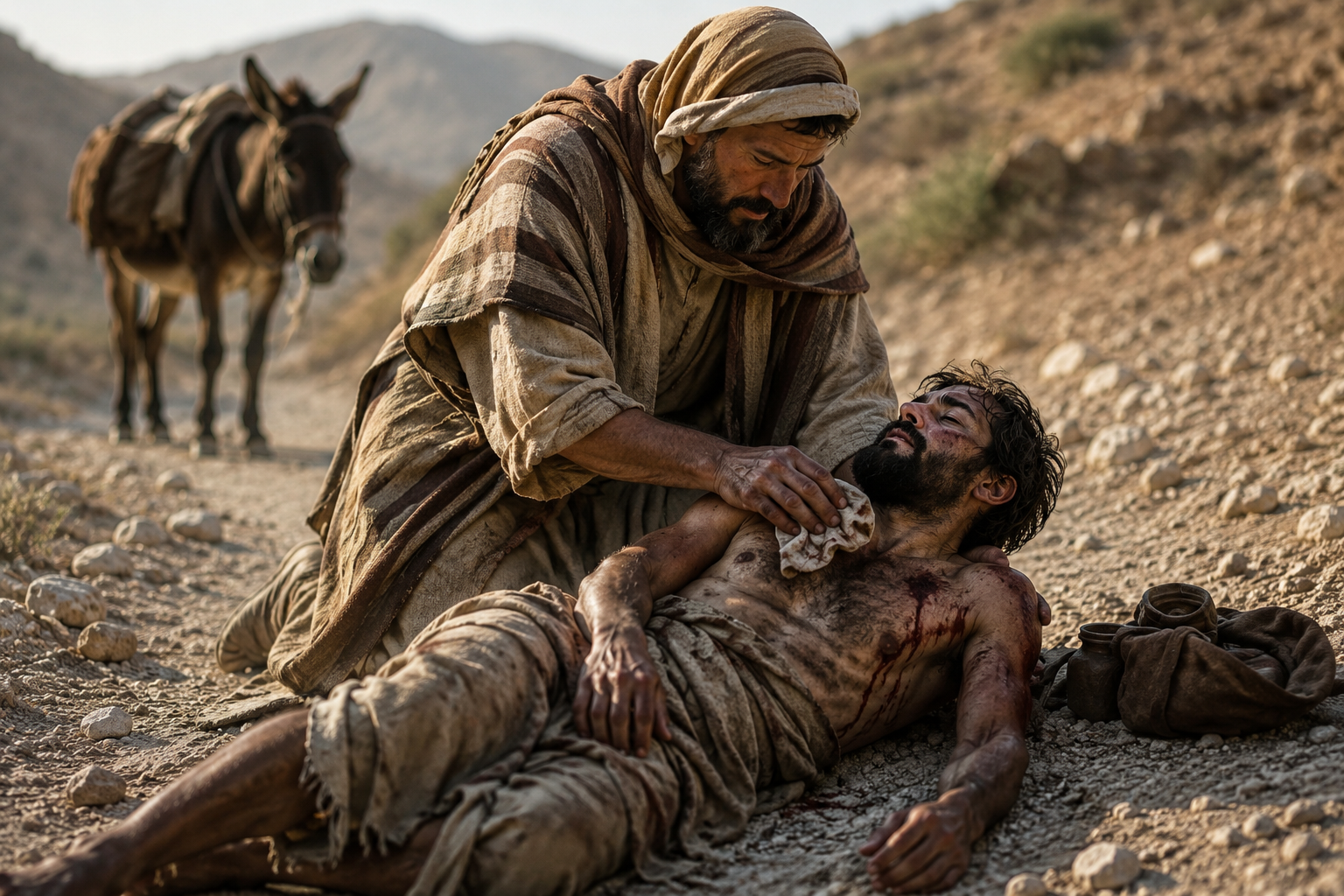
Jesus tells a parable in Luke 10:25–37. This parable tells the story of a man traveling on the road from Jerusalem to Jericho who was attacked by robbers and left for dead. Two religious leaders passed him by, a priest and a Levite.
That's what gets me, because it is like so many today. They were considered his "neighbors," and yet they felt no responsibility to help him. They had no compassion to stop and help him, despite being supposed religious leaders.
Yet a Samaritan (understand that Samaritans were often despised by Jews in Jesus' time because they were considered outsiders) came upon this man who had been beaten and was moved with compassion to help him. He bandaged his wounds with oil and wine, placed him on his own donkey, and took him to an inn.
The Samaritan then paid the innkeeper two silver coins to cover the man's expenses and even promised to reimburse any additional costs upon his return. Jesus then asked which of those three men was truly the neighbor, as we are commanded to love our neighbor as ourselves. The response was, "The one who had mercy on him."
Jesus then said, "Go and do likewise."
My question is for the one who says, "It is not my problem." If it were you lying beaten on that road, would you want someone who could help you to simply walk by because they decided you were not their problem? I know. I have felt the same and have had to check myself. Those who cannot help themselves call us, as a human race, to compassion and responsibility.
Even if someone does not view this from a biblical perspective, the consequences of untreated mental illness, addiction, homelessness, broken families, and failed rehabilitation do not remain isolated. They eventually affect our communities and, in one way or another, impact all of us, if not directly, then perhaps our children or future generations.
Legislation has given us ample opportunity to raise our voices, submit proposals, and provide public comment during committee hearings. We have open forums. Counties, cities, and state agencies regularly hold meetings that are open to the public, providing opportunities for citizens to participate in the legislative and policymaking process.
Have you heard of the Butterfly Effect?
The Butterfly Effect is the idea that even the smallest action can set into motion a chain of events that produce significant and far-reaching consequences. The phrase comes from chaos theory, where the metaphor suggests that the flap of a butterfly's wings could ultimately contribute to changes in weather patterns elsewhere in the world. In everyday life, it reminds us that acts of kindness, compassion, neglect, or indifference rarely end with the person immediately affected. One decision, one conversation, one helping hand, or one missed opportunity to help can ripple (or flow) outward, touching families, communities, and even future generations in ways we may never fully see.
Much like the butterfly effect, the Good Samaritan and all good deeds remind us that one compassionate decision can create ripples far beyond the moment. We may never know how one act of mercy changes the course of another person's life, or the lives of their children and grandchildren. Likewise, choosing to ignore suffering also has consequences that extend far beyond what we can see. Every decision matters.
I close with what Senator Borris stated that somehow I can't get away from, as he posted it publicly on his Facebook page:
"At today’s Texas Health and Human Services Interim Hearing, Senator Borris L. Miles said the Harris County Jail is the NUMBER ONE mental health service provider in the entire State of Texas—a reality shared by many counties across our state. Jails should not serve as mental health providers. It’s time to build a system that ensures people receive the care they need instead of cycling through our criminal justice system."
What do we do as a society and a community to affect the lives of all those facing these realities? The mentally ill, the drug addicted, the alcoholic, the homeless, the incarcerated? The orphaned? The widowed? The oppressed in some form or another? What about those who face eventual dementia or Alzheimer’s disease, or an unexpected accident that derails the course of their life, leading to depression, another form of mental illness? The unexpected that no one prepares for.
Perhaps you know of organizations such as NAMI, other advocacy groups, ministries, treatment programs, housing resources, or other unheard-of organizations making a difference. If so, please share them. Someone reading these comments may find the help they have been desperately searching for.
I would love comments because it truly takes a village...
Comments
Comments are reviewed before they appear. Please be kind and respectful.
Be the first to leave a comment.
Leave a comment